







Primary & Preventive Care
Respiratory Failure Nursing Care Plan Template
A Respiratory Failure Nursing Care Plan Template provides clinicians with a syst...

March 17, 2026


Buy now, pay later is now available in Pabau

Dermatology consent forms protect both patients and practitioners by documenting informed consent before treatment.
Consent must cover specific risks: scarring, infection, permanent discoloration, and nerve damage for each procedure type.
Digital consent forms streamline workflows and ensure compliance with HIPAA and state medical board requirements.
Required signatures: patient consent plus provider/employee signature for legal validity.
Pre-treatment consent screening prevents liability claims and strengthens clinical documentation standards.
A dermatology consent form is the legal and ethical foundation of safe clinical practice. Before any dermatological procedure-whether skin biopsy, laser treatment, chemical peel, or injection therapy-patients must understand what the procedure entails, what risks they face, and what alternatives exist. This informed consent process protects both the patient and your practice. A well-structured dermatology consent form documents this exchange, reducing liability and ensuring compliance with medical board requirements across all jurisdictions. This guide walks you through what a dermatology consent form must include, how to implement it digitally, and how to integrate it into your clinical workflow.
A comprehensive informed consent form covering skin biopsies, liquid nitrogen treatments, cortisone injections, risk disclosures, and signature requirements for medical and aesthetic dermatology practices.
Download template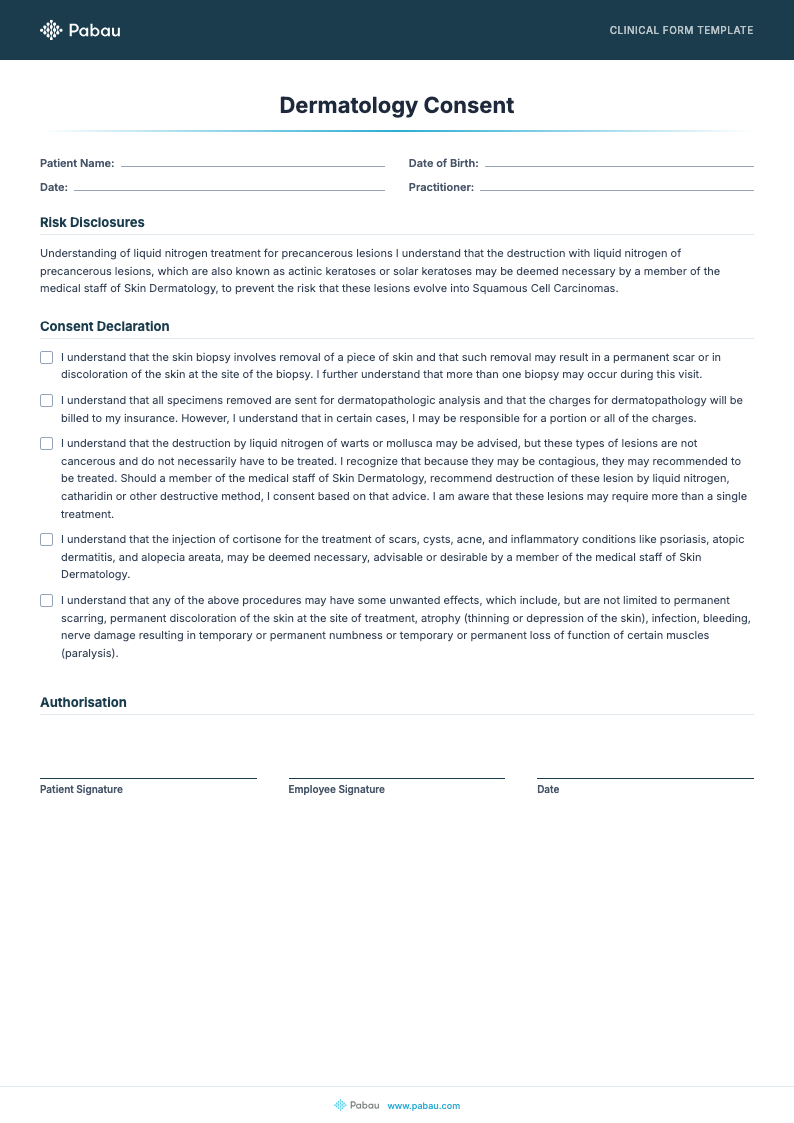
A dermatology consent form is a legal document that demonstrates informed consent-a patient’s voluntary agreement to undergo a dermatological procedure after being fully informed of its nature, purpose, risks, benefits, and alternatives. This is not a waiver of liability; it is proof that the patient understood their options and chose to proceed. Under medical law in most jurisdictions, informed consent is both an ethical obligation and a legal requirement. The FDA and state medical boards mandate that practitioners obtain documented consent before administering procedures involving tissue removal, injections, or energy-based treatments.
The dermatology consent form serves multiple purposes. Clinically, it ensures the patient comprehends the procedure and its risks before treatment begins. Legally, it provides evidence that consent was obtained and documented. Operationally, it standardises the consent conversation across your team, ensuring consistency and reducing staff-dependent variation. A well-drafted form includes procedure-specific details: for skin biopsies, you’d highlight scarring and infection risk; for laser treatments, you’d detail post-inflammatory hyperpigmentation and temporary discomfort; for injectables, you’d address migration and asymmetry concerns. Electronic consent forms elevate this further by creating an audit trail, documenting the exact time consent was obtained, and integrating directly with your clinical records.
Implementing a dermatology consent form requires a structured workflow that integrates the form into your appointment cycle. The template provided covers five core consent declarations based on the most common dermatological procedures. Follow these five operational steps to implement consent documentation in your practice:
This workflow ensures consent is not merely a checkbox but a documented, interactive process that strengthens clinical safety and legal protection.

Pabau's digital forms send consent automatically based on procedure type, track completion, and link responses directly to clinical notes.

Any dermatology practice-medical, aesthetic, or hybrid-benefits from a standardised consent form. Medical dermatology clinics (treating acne, eczema, psoriasis, skin cancer, warts, moles) need consent forms documenting risk disclosures and patient understanding. Aesthetic clinics (offering Botox, dermal fillers, laser hair removal, chemical peels, microneedling) rely on consent forms to prove informed consent before injectable and energy-based procedures. Hybrid practices combining both medical and aesthetic services require procedure-specific consent variants. Multi-location dermatology groups benefit from a centralised template that ensures consistent language and compliance across all clinics. Solo practitioners and small teams can download and customise the template immediately without building forms from scratch.
Whether you’re a dermatologist, nurse practitioner with prescriptive authority, physician assistant, or aesthetic nurse in a dermatology clinic, a comprehensive consent form protects your practice. Patients of all ages benefit-though practices treating minors must ensure parental/guardian consent and compliance with state age-of-consent rules for cosmetic procedures (which vary by state and procedure type). The template is equally applicable to private practices, hospital-based dermatology departments, and med spas where licensed dermatologists oversee treatments.
Legal protection: A signed consent form demonstrates that the patient understood the procedure, its risks, and alternatives. In litigation, this document proves informed consent was obtained. Medical malpractice insurers expect comprehensive consent documentation; practices without it face higher claims denial rates.
Compliance with regulatory bodies: Medical boards, CQC (UK), GMC (UK), and GDPR (EU/UK) require documented consent for procedures. Practices lacking formalised consent workflows risk regulatory findings during inspections.
Reduced liability claims: Patients who sign a consent form acknowledging risks are less likely to sue if a disclosed risk materialises. The form creates a paper trail showing informed decision-making. Practices with strong consent documentation win more malpractice defence summaries at the pleading stage.
Improved clinical communication: Walking a patient through a consent form forces the clinician to explain risks clearly and answer questions. This conversation builds trust and sets realistic expectations. Patients feel heard and involved in treatment decisions.
Operational efficiency: A standardised form eliminates ad-hoc consent conversations and reduces staff burden. Practices using digital forms with automatic delivery and tracking save hours monthly on manual form distribution and filing. Electronic signatures reduce paper and storage costs.
Audit your consent process annually. Pull 10 random patient charts and verify that signed consent forms exist, are dated, include all required signatures, and are stored in the patient record. Practices with strong audit trails face fewer defence challenges in litigation.
Informed consent is grounded in medical ethics and law. The doctrine requires that before any procedure, a clinician must disclose material risks (those a reasonable patient would consider important in deciding whether to proceed) and obtain voluntary agreement. Failure to obtain informed consent is battery under tort law, regardless of clinical outcome. This legal standard applies across all 50 US states and internationally (UK, EU, UAE, Australia, Canada).
The FDA requires that labelling for approved dermatological products (lasers, injectables, topical agents) include risk information. Any procedure using an FDA-approved device or drug must disclose the labelled risks. Off-label treatments (e.g., using Botox for conditions not FDA-approved) require even more robust consent documentation, including explicit acknowledgment that the treatment is off-label and not FDA-approved for that indication.
State medical boards expect documented informed consent in patient records. CQC inspections (UK) and GMC guidance (UK) mandate that practitioners maintain evidence of consent discussions. GDPR (Europe/UK) requires consent to process health data; separate informed clinical consent and separate data processing consent both apply. HIPAA (US) does not mandate specific consent forms but does require that patients be informed of their privacy rights; combining this with clinical informed consent in a single comprehensive form is best practice.
For minor patients (under 18, varies by state), parental or legal guardian consent is required. Some states permit minors aged 16-17 to consent to certain procedures independently (check your state medical board’s guidance). The dermatology consent form should include a line for parent/guardian signature when applicable and should note the patient’s age at the top.
Paper consent forms work but create friction. Digital consent forms (e-signatures via secure patient portals) are legally equivalent to paper under the ESIGN Act (US) and Electronic Communications Regulations (UK) when the system maintains an audit trail, authenticates the signer, and preserves the signed document. Practices using practice management platforms with built-in digital forms and e-signature can deliver consent 24-48 hours pre-appointment, receive completion notifications, and archive automatically. This workflow:
When selecting a digital forms platform, ensure it supports e-signatures, HIPAA/GDPR compliance, multi-device delivery (email, SMS, patient portal), and integration with your EHR or practice management system. The consent form should be linked to the specific appointment and procedure code to maintain clinical context.

Need a consent form tailored to your procedures? Facial Consent Form Template provides a ready-to-use template for facial aesthetic procedures including injectables and laser treatments.
Seeking a system that automates consent delivery? Digital Forms Software enables automated consent delivery, e-signature capture, and integration with patient records in a single platform.
Looking for compliance guidance on patient consent? Compliance Management Software tracks consent completion and regulatory adherence across your practice.
A comprehensive dermatology consent form is the cornerstone of ethical, legal dermatology practice. It protects your patients by ensuring they understand what they’re consenting to, and it protects your practice by documenting informed decision-making. Whether you’re offering skin biopsies, laser treatments, injectables, or topical therapies, a standardised consent process-implemented digitally for efficiency-reduces liability, ensures compliance, and strengthens the clinician-patient relationship. Download the template provided above, customise it for your procedures, and integrate it into your appointment workflow. Your practice’s legal exposure and patient trust will both improve.
A dermatology consent form is not a binding contract in the sense of limiting liability. It is evidence that informed consent was obtained. It demonstrates that the patient understood the procedure and its risks, and voluntarily agreed to proceed. In litigation, it shifts the burden to the plaintiff to prove that consent was not informed. Courts and juries view documented consent very favourably in defence cases.
Yes. Consent can be withdrawn at any time before or during the procedure. If a patient says they no longer want to proceed, the clinician must respect that choice. Document any withdrawal of consent in the patient record. The signed form remains valid for past consent but does not bind the patient to future procedures.
Do not proceed with the procedure. Document in the chart that the patient declined to sign. Consider rescheduling to allow time for discussion, or offering a telehealth consultation to address concerns. If a patient truly refuses consent, proceeding anyway constitutes battery and exposes you to significant liability.
Retain signed consent forms for the same duration as the patient’s medical record. Standard practice is a minimum of 7 years from the date of treatment (or 7 years from the patient’s last visit). Some states require longer retention; check your state medical board’s rules. For minors, retention extends 7 years past the age of majority (age 18 in most states).
Best practice is to have procedure-specific consent declarations. A single dermatology consent can cover multiple procedures if they share similar risks (e.g., “liquid nitrogen destruction” and “laser treatment” can appear on the same form if both involve thermal injury risks). However, if procedures carry vastly different risks, separate consent forms improve clarity and reduce liability.
Yes, under the ESIGN Act (US) and Electronic Communications Regulations (UK/EU). Digital signatures are legally equivalent to handwritten ones provided the system creates an audit trail (timestamps, IP address, user ID), authenticates the signer (secure login), and preserves the signed document unaltered. Most practice management platforms with e-signature functionality meet these requirements.