







Primary & Preventive Care
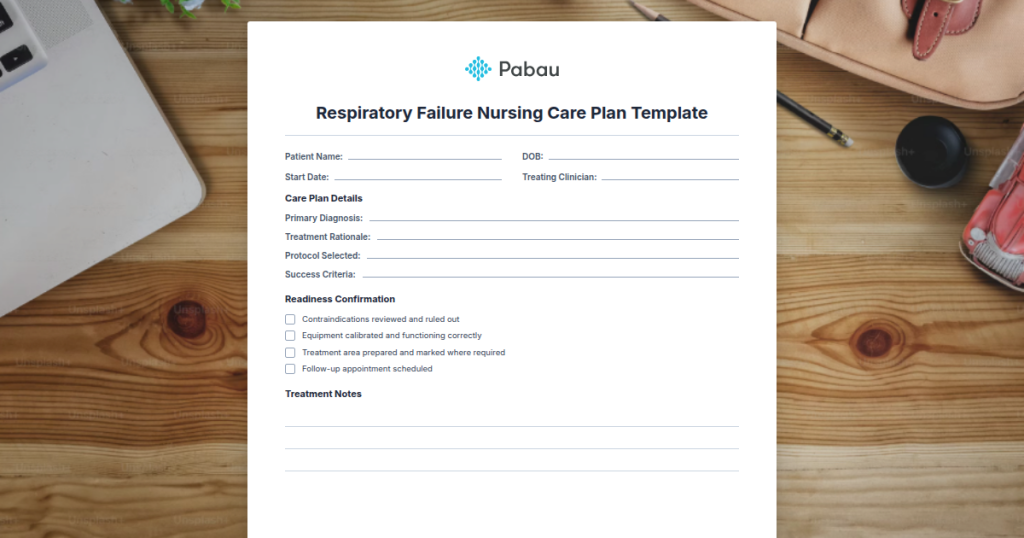
Respiratory Failure Nursing Care Plan Template
A Respiratory Failure Nursing Care Plan Template provides clinicians with a syst...

March 17, 2026


Buy now, pay later is now available in Pabau

Standardised dermatology intake forms capture essential medical history and consent upfront.
Digital forms with conditional logic reduce data entry errors and compliance gaps.
HIPAA-compliant documentation protects patient privacy and your clinic legally.
Pre-visit completion via SMS or email boosts appointment efficiency by 20+ minutes.
Mobile-optimised forms allow patients to upload skin photos and complete forms on-site.
A dermatology intake form is far more than a checklist. It’s your first clinical interaction with a patient-a structured conversation that captures medical history, documents skin concerns, screens for contraindications, and establishes informed consent before treatment. Done well, it streamlines workflows. Done poorly, it creates compliance gaps and clinical risk.
Most dermatology clinics rely on paper forms or generic templates that don’t reflect dermatology-specific workflows. Patients skip sections, handwriting becomes illegible, data entry takes hours, and critical information (allergies, past reactions, cosmetic procedure history) gets missed. Digital dermatology intake forms solve this by guiding patients through structured medical history questions, capturing consent automatically, and feeding data directly into patient records.
This guide covers how to create an effective dermatology intake form, what sections must be included, how to implement it digitally, and how to stay compliant with healthcare regulations across the UK, US, and other jurisdictions.
A ready-to-use intake form covering patient demographics, medical history, allergy screening, medication lists, skin condition assessment, contraindication disclosures, consent declarations, and signature blocks. Fully customisable for medical and cosmetic dermatology practices.
Download template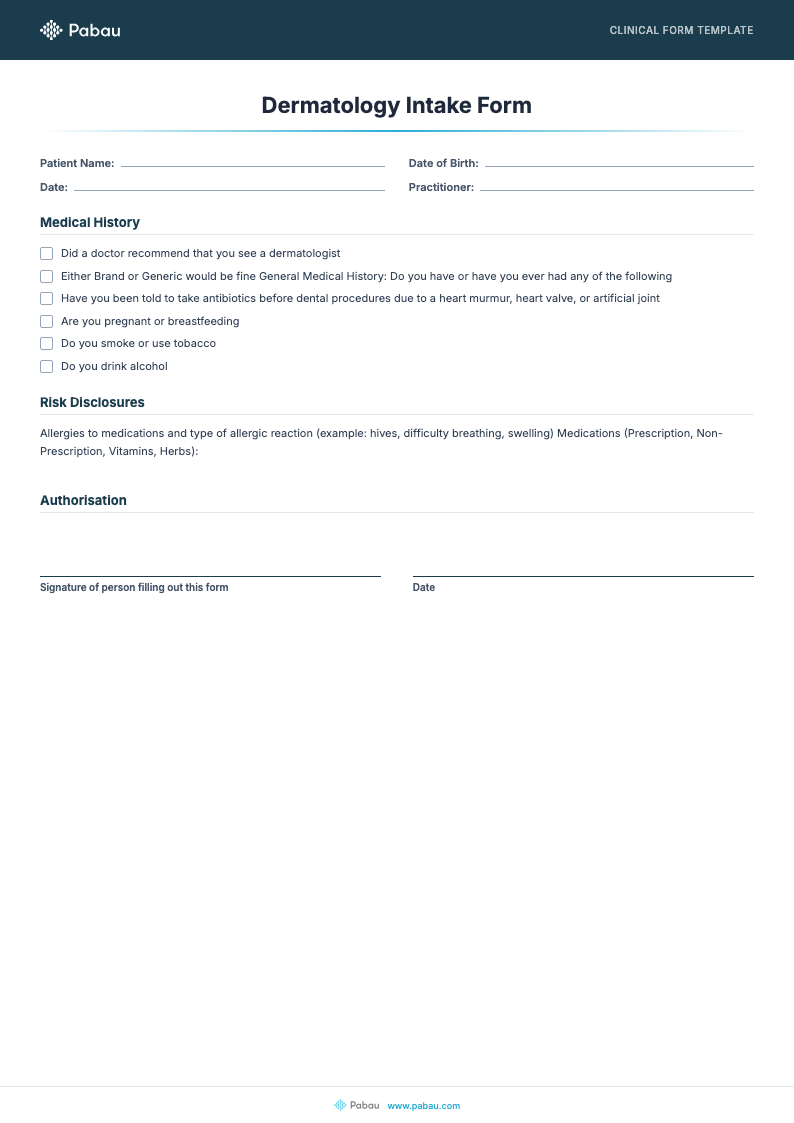
A dermatology intake form is a comprehensive medical questionnaire that collects patient information necessary before dermatological consultation or treatment. It serves three critical purposes: capturing baseline medical history, documenting skin concerns and treatment goals, and obtaining informed consent for proposed treatments.
In medical dermatology-managing conditions like acne, eczema, psoriasis, and infections-the form documents past treatments, medication allergies, and systemic conditions affecting skin health. In cosmetic dermatology-Botox, dermal fillers, laser treatments, chemical peels-the form screens for contraindications, documents patient expectations, discloses treatment risks, and obtains written consent before the procedure.
Legally, the intake form serves as evidence of informed consent. It demonstrates that a patient understood treatment risks, had the opportunity to ask questions, and agreed to proceed. Without documented consent, clinics face regulatory exposure under healthcare compliance standards (HIPAA in the US, GDPR in the UK, CQC guidance in NHS-partnered practices) and professional liability claims if adverse outcomes occur.
From a workflow perspective, a well-structured dermatology intake form reduces appointment time spent on data gathering. When patients complete forms pre-visit on mobile devices or in-office tablets, clinicians spend consultation time on clinical assessment rather than paperwork. Digital intake forms with conditional logic-where follow-up questions appear based on earlier answers-ensure comprehensive data capture without overwhelming patients with irrelevant fields.
Implementing a dermatology intake form effectively requires planning around three key moments: pre-appointment, in-office review, and post-appointment archiving. The following five-step workflow ensures compliance, reduces data loss, and streamlines clinical documentation.
This workflow takes 15-20 minutes total per patient and prevents the common scenario where clinicians discover critical allergies or contraindications during treatment rather than before.

Pabau's digital forms system automates pre-visit completion, conditional logic, and clinic-to-EHR data flow. Book a demo to see how practices cut consultation setup time by 20+ minutes.

Any dermatology practice-medical, cosmetic, or mixed-benefits from a standardised intake form. But specific clinic types face particular compliance and workflow challenges that intake forms address.
Medical dermatology clinics managing conditions like acne, rosacea, psoriasis, eczema, and skin infections need comprehensive medical history to inform treatment decisions. A patient’s past antibiotic use, steroid sensitivity, or concurrent immunosuppressive therapy directly affects which treatments are safe. An intake form ensures this data is captured and reviewed before prescribing.
Cosmetic dermatology and aesthetic practices treating Botox, fillers, laser hair removal, and chemical peels face the highest legal exposure. Patients must understand procedure risks, expected outcomes, and post-treatment restrictions. A signed consent form documenting patient education and agreement is your primary defence against “I didn’t expect that result” disputes or regulatory complaints. Cosmetic procedures also require photo documentation and consent for before-and-after images-the intake form captures this.
Multi-location dermatology groups need standardised forms across all clinics to ensure consistency and compliance. A centralised intake form with conditional logic based on appointment type (initial consultation, follow-up, cosmetic procedure) reduces variation and ensures no clinic misses critical screening questions.
Dermatology clinics in regulated healthcare systems (UK CQC-registered clinics, US practices billing to insurance) require auditable documentation of informed consent and contraindication screening. A paper form sitting in a filing cabinet is difficult to audit; a digital form timestamped and linked to the treatment appointment is audit-ready.
Compliance and legal protection. A documented dermatology intake form proves informed consent was obtained. Regulatory bodies (CQC, FDA, state medical boards) expect clinics to document that patients understood treatment risks. A signed intake form is evidence. Without it, you’re vulnerable to regulatory findings or malpractice claims if a patient alleges they didn’t consent to a procedure or weren’t warned of a complication.
Contraindication screening before treatment. Many dermatology treatments have absolute and relative contraindications. Laser hair removal is contraindicated during pregnancy or while taking isotretinoin. Botox is contraindicated in patients with neuromuscular disorders. A structured intake form systematically screens for these conditions, preventing unsafe treatments. When a contraindication is identified and documented, it also protects you if a patient later claims treatment was inappropriate.
Reduced appointment time and improved clinical efficiency. Pre-visit form completion eliminates the 10-15 minutes usually spent in appointment gathering medical history. Clinicians can spend this time on clinical assessment, patient consultation, and treatment planning. Digital forms with conditional logic (e.g., “If patient reports skin sensitivity, ask about previous reactions to topical treatments”) guide data capture without asking irrelevant questions, improving completion rates.
Improved data quality and legibility. Handwritten forms generate illegible notes, skipped fields, and data loss during filing. Digital forms enforce required field completion and store data in searchable, legible formats. Allergy information, medication lists, and contraindications are instantly accessible during clinical consultation or future appointments.
Audit readiness and regulatory compliance. Digital intake forms timestamped and linked to treatment appointments create an audit trail. Regulators auditing your practice can instantly verify that informed consent was obtained, contraindications were screened, and documentation is complete. This is significantly easier than manually reviewing paper files.
Consistency across multi-location practices. Standardised intake forms ensure all clinics in a group follow the same screening and consent process. This reduces liability variation and ensures no patient is missed due to form inconsistencies.
Filter your intake form questions by appointment type. Create a ‘new patient, medical dermatology’ version asking about past treatments and conditions, a ‘cosmetic procedure’ version with detailed risk disclosures, and a ‘follow-up consultation’ version with abbreviated history. This reduces form fatigue for repeat patients while ensuring all essential data is captured for new patients or treatment changes.
An effective dermatology intake form includes eight core sections. Not every section applies to every patient (a follow-up appointment may skip some questions), but all should be available in your template for flexibility.
Capture full name, date of birth, contact details, emergency contact, and insurance information. This is standard in all healthcare forms. Dermatology-specific: note patient skin type (Fitzpatrick scale I-VI if available) and ethnicity, as these affect treatment recommendations and post-procedure risk (e.g., post-inflammatory hyperpigmentation is more common in darker skin types).
Ask patients to describe their main skin concern in their own words: “What skin problem brings you in today?” and “What would you like to achieve?” For cosmetic treatments, document specific goals: “Reduce fine lines on forehead” or “Lighten dark spots on cheeks.” This creates a record of patient expectations, essential for managing satisfaction and defending against claims of inadequate results.
Include general medical history relevant to dermatology: autoimmune conditions, immunosuppression, past skin cancers, bleeding disorders, keloid history, and previous adverse reactions to treatments. Ask about current and past dermatological treatments: topical steroids, retinoids, antibiotics, phototherapy, surgical procedures, and cosmetic treatments (Botox, fillers, laser). This reveals treatment tolerance and complication history.
Request a full list of current medications (prescription, over-the-counter, vitamins, herbs) because many interact with dermatology treatments. Anticoagulants increase bruising risk. Immunosuppressants delay wound healing. Certain supplements increase photosensitivity. Ask about drug allergies (rash, anaphylaxis, urticaria) and type of reaction. Include specific screening for anaesthetic allergies if your clinic uses topical or injectable anaesthetics.
Ask about current skin symptoms: itch, pain, bleeding, drainage, scaling, or sensitivity. For acne, ask about severity, distribution, and previous treatments. For rosacea, ask about triggers. This guides clinical assessment and documents the baseline state before treatment.
List specific contraindications relevant to your most common treatments. For laser treatments: current sun exposure, recent sunburn, pregnancy, isotretinoin use, photosensitising medications, metallic tattoo ink. For injectable treatments: bleeding disorders, anticoagulant use, pregnancy, immunocompromise. For chemical peels: keloid history, dark skin types (higher risk of post-inflammatory hyperpigmentation). A yes answer doesn’t automatically disqualify treatment; it triggers a conversation with the clinician about risk-benefit.
Include treatment-specific risk disclosures. For Botox: temporary paralysis, headache, infection, asymmetry, brow droop. For fillers: bruising, swelling, allergic reaction, migration, infection. For laser: redness, blistering, post-inflammatory hyperpigmentation (especially in darker skin), scarring, change in skin texture. Include a statement that the patient has had an opportunity to ask questions and consents to the proposed treatment. Many practices use checkbox consent: “I understand the risks and benefits listed above and consent to this treatment.” Have patients initial or sign.
For aesthetic practices, include consent to photograph the patient before and after treatment for clinical records and potential case study use. Specify how photos will be stored (secure patient portal, encrypted server), who has access (clinical team only, or also for marketing with patient permission), and how long they’ll be retained. This is a HIPAA compliance requirement if you’re based in the US, and aligns with GDPR in the UK.
End with a statement: “I certify that the information provided above is accurate and complete. I have read and understand the consent and risk disclosure sections above.” Have the patient sign and date. If the patient is a minor, a parent or legal guardian must sign. Some practices also have the clinician countersign to confirm they reviewed the form and discussed key risks with the patient.
Paper forms and digital dermatology intake forms both collect the same information, but implementation and workflow differ significantly. Digital forms offer concrete operational advantages for dermatology practices of any size.
Conditional logic. Digital forms can show or hide questions based on earlier answers. If a patient selects “No” to “Have you had previous cosmetic treatments?”, follow-up questions about past filler reactions don’t appear. This reduces form length for applicable patients while ensuring comprehensive data from those who need more questions. Paper forms cannot do this.
Mobile completion. Digital forms respond to mobile devices. Patients complete them on their phone at home, or on an in-office tablet in the waiting room. Paper requires pen and legible handwriting, which many patients struggle with. Mobile forms also allow photo uploads (patients can photograph a skin concern and attach it to their form for the clinician to review pre-appointment).
Automatic data population into records. Digital intake data feeds directly into the patient’s electronic health record (EHR). Clinicians see medical history, allergies, and contraindication screening already entered in the treatment note template. Paper requires manual entry or scanning, adding steps and error risk.
Compliance audit trail. Digital forms timestamp when the form was completed, who completed it, and which device/IP address was used. This creates an audit trail. Paper forms have no timestamp unless manually noted.
Accessibility and searchability. Digital forms are searchable-you can pull up every patient who reported isotretinoin use, or every patient with a documented filler allergy, in seconds. Paper filing requires manual review of folders.
Dermatology intake forms collect Protected Health Information (PHI): medical history, allergies, treatment history, and often photos of skin conditions. In the US, HIPAA requires that clinics safeguard PHI through encryption, access controls, and audit logs. In the UK, GDPR and NHS/CQC standards require similar protections plus explicit patient consent for photo storage.
If you use digital forms, ensure they are HIPAA-compliant (if US-based) by verifying: encrypted transmission (HTTPS), encrypted storage at rest, access restricted to authorised staff, automatic logouts, and audit trails. Cloud-based form platforms should provide a Business Associate Agreement (BAA) in the US. Patient data should never be exported or downloaded to unencrypted USB drives or personal devices.
For photo storage, many regulatory bodies recommend keeping photos separate from identifying information (photo linked by patient ID number rather than name on the image itself). If photos are used for case studies or before-and-after galleries, written consent must specify this use and be revocable at any time.
Where and when patients complete intake forms affects data quality and appointment flow. Most practices use a hybrid approach.
Pre-visit completion (24-48 hours before appointment). Send forms via SMS link or patient portal. This gives patients time to gather medication lists and insurance cards. Clinic staff receive the completed form, review for red flags (allergies, contraindications, incomplete answers), and contact the patient if clarification is needed. Advantage: clinic staff see the data before the appointment and can prepare (alert the clinician, have the dermatologist review contraindications, gather specific consent templates if needed).
In-office completion (arrival or during waiting time). Patients complete forms on an in-office tablet in the waiting area immediately before the appointment. Advantage: ensures current information (medications, symptoms). Disadvantage: takes 10-15 minutes from the appointment slot, reduces available consultation time.
Hybrid approach (recommended). Send a brief form 48 hours before: chief complaint, medications, allergies, contraindication screening (yes/no answers). Ask patients to complete it before arrival. At check-in, staff review the form (2-3 minutes), ask clarifying questions if needed, and have the clinician review for red flags. During the appointment, the clinician walks through consent and risk disclosure in detail, and the patient signs the full consent form in-office. This balances efficiency with data completeness and ensures the clinician has time to discuss risks rather than rushing through a form.
Build your dermatology intake form with a ‘summary for clinician’ section visible only to staff. After a patient submits a form digitally, your system extracts key data (allergies, contraindications, previous reactions, treatment goals) and displays it in large, easy-to-scan text above the full form. This takes a clinician 20 seconds to review before walking into the treatment room, ensuring critical information is never missed.
Different dermatology presentations benefit from tailored intake form variations. Rather than a single one-size-fits-all form, segment your intake process by appointment type.
Focus intake questions on symptom severity, past treatment response, and systemic conditions. Ask: “How long have you had acne?” “Which treatments have you tried?” “Did any make it worse?” “Do you have a family history of atopic dermatitis?” Screen for medications that worsen these conditions (beta-blockers worsen rosacea; some immunosuppressants worsen infection risk). Ask about sun exposure, diet triggers, and stress, as these affect medical dermatology management.
Emphasise risk disclosure and contraindication screening. Ask: “Have you had this treatment before? Any side effects?” “Are you pregnant or planning pregnancy in the next 3 months?” “Are you currently taking blood thinners?” “Do you have keloids or a history of poor wound healing?” “What are your expectations for this treatment?” Include detailed consent sections specific to each procedure (e.g., Botox consent includes risk of brow droop, headache, infection; filler consent includes risk of migration, vascular occlusion, allergic reaction). Screen for photosensitising medications, recent sun exposure, and active skin infections (contraindications for many laser treatments).
Most modern practice management platforms support digital intake forms with dermatology-focused features. Implementation steps are similar across systems.
Step 1: Choose or build your template. Start with a pre-built template (many platforms offer dermatology-specific versions) or adapt the free template above. Customise questions to your clinic’s treatments, location-specific regulations, and unique workflows. Remove irrelevant sections to reduce patient burden.
Step 2: Configure conditional logic. Set up skip-logic rules: if a patient answers “No” to “Have you had cosmetic treatments before?”, hide the follow-up question “Did you experience any complications?” This reduces form length and improves completion rates.
Step 3: Add photo upload fields (if relevant). Include optional fields allowing patients to photograph and attach their skin concern. This helps clinicians assess severity before the appointment and ensures the patient and clinician are discussing the same area.
Step 4: Set up automated delivery. Configure the system to send the form via SMS or email automatically when a dermatology appointment is scheduled. Include a deadline (“Please complete by [date]”) and a link to a mobile-friendly form.
Step 5: Configure EHR integration. Map form fields to your patient record so answers populate automatically into the appointment note. Allergy and contraindication data should appear prominently in the clinical summary clinicians see pre-appointment.
Step 6: Test and refine. Have your team (front desk, clinical staff, clinicians) complete test forms. Identify confusing questions, missing fields, or technical issues. Refine before rolling out to patients.
Step 7: Train staff and communicate to patients. Ensure front desk staff know when to send forms, how to follow up if forms aren’t completed, and how to handle patients who complete forms in-office. Inform patients of the new process via appointment confirmation emails and phone calls: “Your appointment is scheduled for [date]. You’ll receive an intake form link to complete at home before arrival-it takes about 5 minutes.”

Need to streamline dermatology consultations? Dermatology EMR Software guides you through essential features for medical and cosmetic dermatology practices, from intake form automation to before-and-after photo documentation.
Want to understand conditional form logic? Digital Forms Feature Overview explains how modern practice management platforms reduce form length by showing only relevant questions based on patient responses.
Looking to improve pre-visit patient communication? Automated Pre- and Aftercare Emails shows how to send intake forms, appointment confirmations, and post-treatment instructions in a coordinated workflow.
A well-designed dermatology intake form is a cornerstone of safe, compliant, and efficient dermatology practice. It captures essential medical history, screens for contraindications, documents informed consent, and feeds data into clinical workflows automatically when implemented digitally. Whether you’re managing acne in a medical dermatology clinic or performing cosmetic procedures, a standardised intake form ensures no patient is missed and every treatment is documented as advised.
The dermatology intake form template above is ready to download and customise. Use it as a starting point, adapt it to your clinic’s specific treatments and patient population, and implement it digitally if possible. Your clinic workflow, compliance posture, and patient safety will all improve.
A comprehensive dermatology intake form should include patient demographics, chief complaint and treatment goals, medical history (especially autoimmune conditions and past skin treatments), medication and allergy screening, skin condition assessment, contraindication screening specific to your treatments, consent and risk disclosure, and photo consent (if your practice takes before-and-after photos for cosmetic procedures). See the “What to Include” section above for detailed guidance on each section.
Digital intake forms reduce appointment time spent on data gathering by 10-15 minutes, as patients complete forms before arrival. Pre-visit review alerts clinicians to contraindications or allergies before treatment starts. Automatic data population into patient records eliminates manual entry. Conditional logic ensures relevant questions are asked without overwhelming patients. Staff can triage forms immediately upon submission (flagging incomplete answers or red flags) rather than discovering issues during the appointment.
Online dermatology forms can be HIPAA-compliant if they meet HIPAA requirements: encrypted transmission, encrypted storage, access restricted to authorised staff, audit logs, and automatic logouts. Cloud platforms must have a Business Associate Agreement with your clinic. Not all online forms are HIPAA-compliant-verify your form platform’s security certifications before use if you handle US patient data.
Yes. Modern practice management systems build mobile-responsive intake forms that work on smartphones and tablets. Mobile completion increases form completion rates (patients find it more convenient than pen and paper) and allows photo uploads directly from a device camera, useful for dermatology practices asking patients to photograph their skin concern.
Absolute contraindications are conditions that make treatment unsafe and should be deferred or declined. Example: pregnancy is an absolute contraindication for most cosmetic dermatology procedures. Relative contraindications are conditions requiring precautions or treatment modifications but don’t prevent treatment entirely. Example: sun exposure in the past 48 hours is a relative contraindication for laser treatment (the clinician may proceed with patient consent and extra sun protection guidance). Your intake form should screen for both and include space for clinicians to document how relative contraindications were managed.
5-15 minutes depending on form length and complexity. A targeted form (e.g., “follow-up consultation for acne”) may take 5 minutes. A comprehensive new-patient form covering medical history, allergies, contraindications, and consent may take 10-15 minutes. Digital forms with conditional logic (hiding irrelevant questions) are typically faster than paper forms. Most clinics target 10 minutes as a reasonable standard.